
How to Choose a Professional Coach: A proven 5-Step Framework for Smart Decisions
Executive Summary
Choosing a coach is a meaningful professional decision — one that deserves the same clarity you would bring to hiring a key member of your team. The coaching market is broad, and the range of quality within it is equally wide. This article offers a structured, practical framework to help you move from general interest in coaching to a confident, well-reasoned decision about whom to work with. It does not tell you which coach to choose. It gives you the right questions, the right criteria, and a reliable sequence to follow so that you can make that decision yourself — with clarity and without pressure.
If you have ever wondered how to choose a professional coach who genuinely moves your thinking forward from one who simply sounds credible — this article is for you. Read on for a step-by-step framework that will help you ask the right questions, recognize the right signals, and make a decision you can stand behind.
- Why Choosing a Coach Requires a Framework
- Step 1: Clarify What You Actually Need Before You Start Looking
- Step 2: Screen for Professional Standards Before Anything Else
- Step 3: Assess Relevant Experience — Without Overweighting It
- Step 4: Use the Discovery Session as a Diagnostic Tool
- Step 5: Evaluate Fit as a Distinct Criterion
- Step 6: Clarify the Practical Structure Before You Commit
- What to Do When You Are Genuinely Unsure
- The Final Principle: The Right Coach Is the One Who Helps You Think
Why Choosing a Coach Requires a Framework
Most people approach the coach selection process informally. They search online, read a few profiles, notice someone who sounds credible, and book a call. Sometimes that works. Often, it leads to a mismatch that costs both time and money — not because the coach was unqualified, but because the fit was wrong, the expectations were unclear, or the selection was based on the wrong signals.
The coaching relationship is, by its nature, a close professional partnership. You will be sharing real challenges, real decisions, and real aspirations. The quality of that relationship directly shapes the quality of the outcomes. A framework does not remove the human element from this choice. It protects it by ensuring the decision is based on substance rather than first impressions or marketing language.
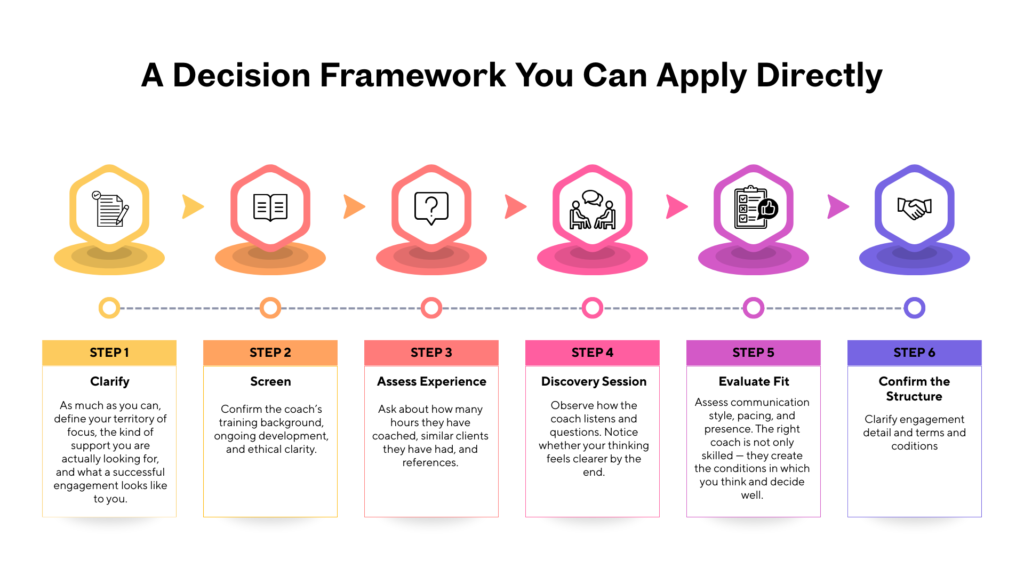
Step 1: Clarify What You Actually Need Before You Start Looking
The most common mistake in choosing a coach is starting the search before defining the need. Without that clarity, you are essentially asking the market to define your priorities for you.
Before you search for a coach, take time to reflect on three foundational questions. Answer them as clearly as you can — but do not wait for perfect answers before moving forward. If some of your responses feel incomplete or uncertain, that is entirely normal. Do not let it cause a delay. One of the specific purposes of a discovery session is for the coach to help you clarify your own needs and goals. You do not need to arrive with everything figured out. You need to arrive with enough to start the conversation.
What is the territory of focus? Coaching can support career transitions, leadership development, business growth, decision-making under pressure, professional communication, work-life integration, and more. These are different territories, and coaches often specialize. Knowing your territory helps you narrow the field immediately.
What kind of support are you actually looking for? This distinction matters more than people expect. If you need expert advice, industry knowledge, or someone to show you what to do, you may need a consultant or mentor rather than a coach. If you need to think more clearly, decide more confidently, and take more purposeful action, coaching is the right structure. Confusing these needs leads to frustration on both sides.
What does a successful engagement look like to you? Not in abstract terms, but specifically. What would need to be true — in your thinking, your behavior, your decisions, or your results — for you to say the coaching was worth it? This question does not need a perfect answer upfront, but it gives you a reference point to use throughout the selection process and the engagement itself.
Step 2: Screen for Professional Standards Before Anything Else
Once you are clear on what you need, the next step is to screen for baseline professional competence. This is not about eliminating good coaches — it is about reducing the ambiguity that comes with an unregulated field.
Start with ICF credentials. An ICF accreditation confirms that a coach has completed assessed training, logged documented coaching hours, and agreed to operate within a defined code of ethics. It is not a guarantee of chemistry or results, but it is a reliable signal of professional seriousness. The ICF’s global directory, available at coachingfederation.org, allows you to verify credentials independently.
It is also worth knowing that not every trustworthy coach holds a formal ICF credential at the time you meet them. Coaches who have been trained in ICF-accredited programs and operate according to ICF standards and ethics represent a broader, equally serious professional community. Many of them are actively working toward their formal credential — building their required coaching hours, completing mentor coaching, and preparing for their performance evaluation. Working with a coach in this category can be a well-founded choice, provided they are transparent about where they are in the process and demonstrate a clear commitment to the ICF framework. Their investment in reaching the credential is itself a meaningful indicator of professional intention.
Verify training and ongoing development. Beyond credentials, a professional coach should be able to tell you where they trained, what ongoing supervision or mentor coaching they engage in, and how they stay current with developments in the field. Coaching skill develops through reflective practice — not just accumulated hours. A coach who invests in their own development is more likely to bring that orientation to their work with clients.
Confirm ethical clarity. A credentialed coach operates under the ICF Code of Ethics, which includes maintaining client confidentiality, avoiding conflicts of interest, and being clear about the scope and limitations of coaching. If any coach is vague about these boundaries or makes claims that coaching will guarantee specific outcomes, that is a meaningful signal to notice.
Step 3: Assess Relevant Experience — Without Overweighting It
Experience matters in coaching, but it matters differently than it does in consulting or mentoring. A coach’s value does not come primarily from their knowledge of your industry or their own professional history. It comes from their skill in facilitating your thinking.
That said, relevant context is not irrelevant. A coach who has worked extensively with professionals navigating leadership transitions, for example, will have encountered the patterns, language, and psychological dynamics of that territory many times. That familiarity supports more fluent, nuanced work — even when the coach is not offering advice based on it.
When evaluating experience, consider three dimensions. First, how many hours of actual coaching have they completed, and with whom? Second, do they have experience with clients in situations that resemble yours — not necessarily the same industry, but similar complexity and stakes? Third, what do client testimonials or references reflect about the quality of the coaching relationship itself, not just the outcomes?
The ICF credential level is a useful proxy for the first dimension. PCC requires a minimum of 500 hours; MCC requires 2,500. These numbers reflect not just volume but the variety and depth that comes with sustained practice over time.
Step 4: Use the Discovery Session as a Diagnostic Tool
Most professional coaches offer an introductory or discovery session before a formal engagement begins. This session is typically free or low-cost, and it serves a clear purpose: to allow both parties to assess fit before making a commitment.
Many clients approach this session as a pitch to be endured. That is the wrong orientation. The discovery session is your primary diagnostic tool. Use it actively.
Listen for how they coach, not just what they say. A skilled coach will demonstrate coaching behaviors even in an introductory conversation. They will listen without interrupting and ask questions that open up your thinking rather than narrow it toward their preferred answers. They will create space for you to reflect, rather than filling the conversation with their frameworks and success stories.
Ask direct questions about their approach. How do they structure a coaching engagement? How do they handle sessions where a client feels stuck? And, how do they distinguish between situations that coaching can address and situations where a different kind of support is needed? A coach who answers these questions clearly and without defensiveness is demonstrating both competence and integrity.
Notice whether they are coaching you toward their services. A professional coach who operates from ICF principles will not use high-pressure sales language, create urgency around signing up, or tell you what you need before understanding your situation. If the discovery session feels more like a sales presentation than a professional conversation, treat that observation seriously.
Assess the quality of your own thinking after the conversation. After a well-conducted discovery session, most clients report feeling clearer — not because the coach gave them answers, but because the conversation helped them think more precisely. That clarity is itself a data point about the quality of the coaching relationship.
Step 5: Evaluate Fit as a Distinct Criterion
Professional competence and personal fit are two separate things. A highly credentialed coach with an excellent track record may not be the right person for you — not because they are not skilled, but because the chemistry, communication style, or working rhythm does not align with how you think and operate.
Fit is not about liking someone. It is about whether the relationship creates the conditions for productive work. Some clients do their best thinking in a coaching environment that is direct and challenging. Others need more space and a gentler pace to go deep. Neither preference is wrong — but the mismatch between client need and coaching style is one of the most common reasons coaching engagements underdeliver.
Assess fit across three dimensions. First, communication style — does this coach’s way of asking questions and offering reflection feel useful to you, or does it feel like friction? Second, pacing — does the session feel rushed, or does it give you adequate time to think before responding? Third, presence — do you feel genuinely heard, or does the coach seem to be moving toward predetermined conclusions?
It is worth noting that a mild level of productive discomfort is not a bad sign. A skilled coach will sometimes surface perspectives that feel uncomfortable, because that is part of the work. The distinction to notice is whether discomfort comes from insight or from a mismatch in style and approach.
Step 6: Clarify the Practical Structure Before You Commit
A professional coaching engagement is a structured, time-bound relationship with clear parameters. Before committing, make sure those parameters are explicit.
Session frequency and duration. Most professional coaching engagements involve sessions of 50 to 60 minutes, meeting bi-weekly or monthly. Some structures use weekly sessions for intensive periods. There is no single right format, but the structure should match the nature of your goals and the pace at which you are able to act between sessions.
Engagement length. Sustainable change takes time. Most professional coaches work in engagements of three to twelve months. Be cautious of very short engagements that promise significant transformation, and equally cautious of open-ended arrangements with no defined review points.
Confidentiality and scope. The coaching relationship should be clearly confidential. If you are being coached in an organizational context where a manager or employer is involved, the scope of confidentiality — what is and is not shared — should be defined explicitly before the engagement begins.
Communication between sessions. Some coaches offer check-ins, email support, or brief message exchanges between sessions. Others do not. Clarify what is included, so expectations are aligned on both sides.
How progress is evaluated. A professional coach should be willing to define — with you — what success looks like and how you will both know the engagement is moving in the right direction. If a coach is unable or unwilling to have that conversation, it raises a reasonable question about accountability.
What to Do When You Are Genuinely Unsure
Decision uncertainty at this stage is normal — and worth taking seriously rather than resolving too quickly.
If you have met with one or two coaches and still feel uncertain, the uncertainty itself is useful information. It may mean your initial criteria were not specific enough. The coaches you have spoken with may not be a strong fit. You probably need more time to clarify what you are actually looking for.
In that case, return to Step 1. Revisit your territory of focus and what a successful engagement looks like to you. Often, the act of articulating those criteria more precisely is enough to make the next step clear.
If you have met with multiple coaches and remain uncertain between two strong candidates, the distinction is likely about fit rather than competence. Trust the signal from the discovery session — specifically, which conversation left you thinking more clearly and feeling more genuinely heard.
A professional coach will not pressure you to decide quickly. If you experience pressure, that itself answers the question.
The Final Principle: The Right Coach Is the One Who Helps You Think
All of the criteria above — credentials, experience, structure, fit — serve a single underlying purpose: to help you identify the coach who will most effectively support your thinking.
Coaching, as defined by the ICF, is a partnering process. The coach does not hold the answers. The coach holds the space for you to find your own. The right coach is not necessarily the most credentialed, the most experienced, or the most articulate in a discovery session. The right coach is the one in whose presence your thinking becomes more precise, your decisions become more confident, and your forward movement becomes more intentional.
That is the standard worth applying — and this framework exists to help you reach it.